
Enterprise Resource Planning: Building Connected and Controlled Business Operations
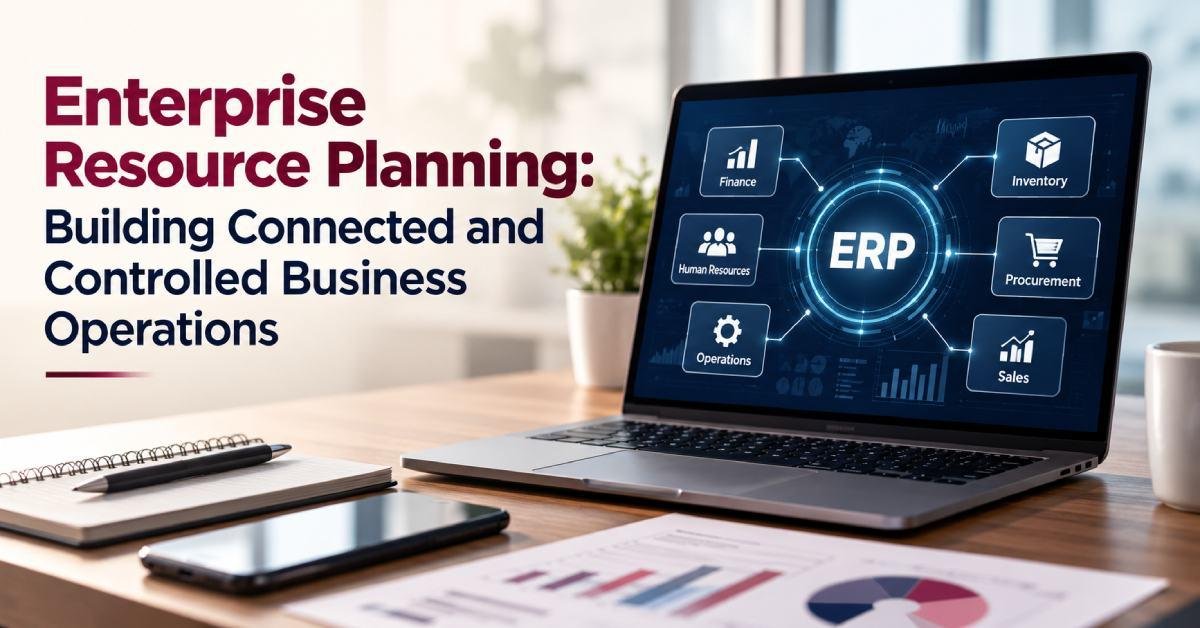
Businesses often manage finance, procurement, inventory, human resources, sales, and reporting through different systems. When these systems do not communicate properly, information can become fragmented, repetitive, and difficult to verify. Enterprise Resource Planning (ERP) provides a structured way to bring important business processes and data together.
Modern ERP systems integrate functions such as finance, HR, manufacturing, supply chain, sales, and procurement through connected modules and a shared data environment. This helps organisations create a more consistent view of business activities and information.
For organisations reviewing their processes, enterprise resource planning services can help assess requirements, define workflows, strengthen financial controls, and support an organised ERP implementation.
What Is Enterprise Resource Planning?
Enterprise Resource Planning is a software-based approach for managing different business functions through an integrated system. Instead of maintaining separate applications and spreadsheets for every department, ERP connects processes and allows authorised teams to work with shared information.
An ERP system may include modules for:
- Finance and accounting
- Procurement and purchasing
- Inventory management
- Sales and order management
- Human resources
- Supply chain management
- Manufacturing
- Fixed asset management
- Budgeting and reporting
These modules generally share common data, helping departments exchange information and reducing dependence on disconnected records.
Why Do Businesses Need Enterprise Resource Planning Services?
Implementing ERP is not simply a technology project. The organisation must understand its existing processes, identify control gaps, determine reporting requirements, and decide how information should move between departments.
This is where enterprise resource planning services become relevant. ERP-related advisory may involve analysing existing workflows, documenting requirements, reviewing internal controls, mapping financial processes, assisting with data migration, and testing the system before implementation.
A structured approach is particularly important because poor process design can transfer existing inefficiencies into the new ERP environment.
How ERP Connects Business Functions
Consider a business where the sales team records an order in one application, inventory is maintained separately, and finance receives transaction details through spreadsheets. This can result in duplicate entries and reconciliation work.
With an integrated ERP environment, information from different processes can flow through connected modules. ERP platforms are designed to provide a common database and a more unified view of organisational information.
For example, a sales transaction may affect inventory records, customer receivables, revenue information, and management reports. Integration can therefore reduce repeated data entry while improving visibility across departments.
Role of ERP in Finance and Accounting
Finance is one of the most important areas within an ERP environment. ERP finance modules can support functions such as accounts payable, accounts receivable, general ledger, expenses, invoicing, asset management, reporting, budgeting, and financial analysis.
This can help finance teams maintain more structured transaction records and prepare financial information using data captured across the organisation.
ERP can also support:
Financial Reporting
Centralised financial information can make it easier to prepare management reports and analyse financial performance.
Reconciliations
Integrated records can reduce the need to manually combine information maintained in separate systems.
Audit Trails
ERP systems can maintain transaction histories and user activity records. Properly configured audit trails can support financial controls and reviews.
Budgeting and Forecasting
Finance teams can use operational and financial data to support budgeting, forecasting, and variance analysis.
ERP and Internal Controls
Technology alone does not create an effective control environment. Controls must be designed according to the organisation's processes, responsibilities, risks, and approval structure.
ERP implementation provides an opportunity to review areas such as:
- User access and authorisation
- Segregation of duties
- Approval workflows
- Vendor creation and modification
- Purchase-to-payment controls
- Order-to-cash controls
- Journal entry approvals
- Master data management
- System-generated reports
- Change management
Modern ERP finance systems can support role-based access, automated workflows, transaction audit trails, and other mechanisms used in financial control environments.
Role of CA Firms in ERP Implementation
The implementation of ERP often requires both technical and financial understanding. While technology teams focus on system configuration and integration, finance and process professionals can examine whether accounting workflows, reporting structures, controls, and documentation are appropriately designed.
Depending on the engagement, CA firms in Delhi may support businesses in areas such as process assessment, accounting configuration review, control mapping, data validation, financial reporting requirements, SOP documentation, and post-implementation review.
Their role may also involve coordinating with management and technology teams to ensure that accounting and compliance requirements are considered during ERP design.
Cloud ERP and Changing Business Requirements
ERP systems can be deployed on-premises, in the cloud, or through hybrid models. Cloud ERP is delivered through the internet and can provide access to business applications from different locations while offering scalability as organisational requirements change.
However, organisations should evaluate deployment options based on factors such as data security, business requirements, integration needs, cost, internal IT capabilities, regulatory considerations, and expected growth.
Important Steps Before ERP Implementation
Before selecting or implementing an ERP platform, management should clearly understand what the organisation expects from the system.
A structured ERP project generally begins with understanding existing processes and identifying areas that need improvement. Businesses should define functional requirements, review existing data quality, map approval structures, determine reporting needs, and establish responsibilities for implementation.
Testing is equally important. Users should verify whether transactions, reports, workflows, access rights, and integrations operate as intended before the system becomes fully operational.
Employee training should also be included because even a well-configured ERP system depends on consistent and accurate usage.
Conclusion
Enterprise Resource Planning can provide a connected framework for managing financial and operational information across an organisation. Its effectiveness, however, depends on more than software selection.
Process design, data quality, internal controls, accounting requirements, user access, testing, and employee adoption all influence the outcome of an ERP project.
Businesses considering enterprise resource planning services should therefore view ERP implementation as a combination of technology, process improvement, financial management, and control design. Professional support, including assistance from CA firms in Delhi, can contribute to evaluating financial processes, controls, reporting requirements, and documentation throughout the ERP lifecycle.
FAQs
1. What is Enterprise Resource Planning?
Enterprise Resource Planning is an integrated system used to manage functions such as finance, procurement, inventory, HR, sales, and operations.
2. What are enterprise resource planning services?
These services may include process assessment, requirement mapping, control design, implementation support, testing, data validation, and ERP review.
3. How does ERP help the finance department?
ERP can integrate accounting transactions, reporting, receivables, payables, assets, budgeting, and other financial processes.

 English
 Arabic
 French
 Spanish
 Portuguese
 Deutsch
 Turkish
 Dutch
Dutch
 Italiano
 Russian
 Romaian
 Greek
Greek