
SerpSpur Alexa Rank Checker: Explore Website Authority, Trust, and Traffic
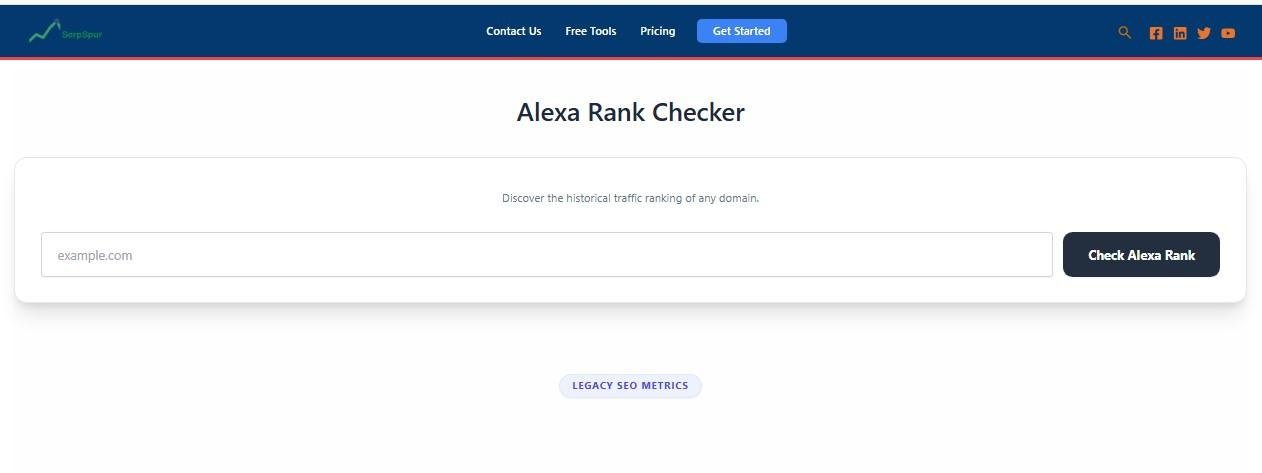
Website owners and SEO professionals have traditionally used ranking and traffic metrics to compare domains. For many years, Alexa Rank was one of the familiar metrics used to estimate website popularity and compare online properties.
Alexa Rank is no longer available, which means marketers now need other ways to research website performance and domain strength.
Instead of depending on one historical ranking number, SerpSpur Alexa Rank Checker takes a broader approach by bringing together several website signals. These include trust-related information, domain authority, and traffic comparisons.
What Is SerpSpur Alexa Rank Checker?
The SerpSpur Alexa Rank Checker is designed to help users research a website from multiple perspectives.
Rather than attempting to reproduce the former Alexa ranking system, SerpSpur focuses on different metrics that can provide additional context about a domain.
The tool highlights three main areas:
- SerpSpur Trust Rate
- Domain Rating and Authority
- Live Traffic vs. Estimates
These measurements can be useful when researching competitors, analyzing domains, evaluating websites, or conducting SEO research.
SerpSpur Trust Rate
The SerpSpur Trust Rate provides a broader way to examine website-related trust and health signals.
Website quality cannot always be understood from traffic alone. A domain may receive visitors while still having technical, security, or authority-related issues.
Looking at multiple signals can therefore help users decide whether a website deserves additional investigation.
For example, website research may involve examining factors such as HTTPS implementation, technical conditions, authority-related signals, and other available domain information.
The Trust Rate should be viewed as an analysis metric rather than a direct Google ranking score.
Domain Rating and Authority
Another important part of the SerpSpur analysis is Domain Rating (DR) and Authority.
Authority-related metrics are commonly used in SEO research to estimate the relative strength of domains. They can help marketers compare websites and identify domains that may be worth researching further.
These metrics can support activities such as:
- Competitor analysis
- Backlink research
- SEO prospecting
- Website evaluation
- Client research
- Domain comparison
It is important to remember that third-party authority metrics are not the same as Google's ranking systems. A high authority score does not guarantee strong rankings for every search query.
Live Traffic vs. Estimated Traffic
Traffic is another important consideration when evaluating websites.
There is a difference between traffic data collected directly from a website and traffic estimates produced by third-party tools. Website owners can access more direct information through platforms such as analytics and search performance tools, while competitor research generally relies on estimates.
SerpSpur's Live Traffic vs. Estimates section helps users examine these figures with that distinction in mind.
When researching another domain, estimated traffic can provide useful context, but it should be considered alongside other signals instead of being treated as an exact measurement.
Why Website Analysis Should Go Beyond Alexa Rank
A single ranking number can make website comparison simple, but it cannot describe every important characteristic of a domain.
For example, a ranking metric does not necessarily explain:
- The quality of a website's content
- Technical SEO condition
- Backlink quality
- Organic keyword visibility
- Indexing status
- Website performance
- Overall search presence
Modern SEO research therefore benefits from combining multiple data points.
This is the principle behind the SerpSpur approach: instead of focusing on one number, users can examine several signals to develop a broader understanding of a website.
Who Can Use SerpSpur Alexa Rank Checker?
SEO Professionals
SEO specialists can use domain-level information when researching competitors, websites, and potential SEO opportunities.
Digital Agencies
Agencies can collect website insights when reviewing client domains or preparing competitor research for campaigns.
Freelancers
Freelancers can use domain analysis as part of website research before preparing SEO recommendations or proposals.
Website Owners
Site owners can compare their domain with competing websites and investigate differences in authority, trust, and traffic-related signals.
Digital Marketers
Marketing professionals can use these metrics as supporting information during market research and competitor analysis.
How to Analyze a Website With SerpSpur
Using the tool can be incorporated into a straightforward research workflow.
Step 1: Select a Domain
Choose the website you want to investigate and prepare the domain for analysis.
Step 2: Run the Analysis
Enter the domain into the SerpSpur Alexa Rank Checker and start the available analysis.
Step 3: Examine Trust Signals
Review the SerpSpur Trust Rate and consider the broader signals associated with the website.
Step 4: Review Authority
Check the available Domain Rating and Authority information to understand the domain's relative SEO strength.
Step 5: Examine Traffic Information
Compare the available traffic information while remembering that estimates and first-party traffic data are not equivalent.
Step 6: Add More SEO Data
For a deeper evaluation, combine the results with keyword rankings, backlinks, technical SEO information, content quality, and organic visibility.
SerpSpur Takes a Multi-Signal Approach
Website evaluation is more useful when multiple factors are considered together.
Think of it like evaluating a vehicle. Speed alone does not tell you everything about its condition. You may also need to consider reliability, maintenance, efficiency, and other characteristics.
Website research works in much the same way.
Trust + Authority + Traffic + Technical Signals + SEO Data
Combining these areas can provide more context than relying on a single popularity score.
Is SerpSpur Trust Rate the Same as Alexa Rank?
No. These metrics serve different purposes.
Alexa Rank was a historical system associated with website popularity and traffic-based ranking.
SerpSpur Trust Rate is an analysis metric intended to provide broader website-related insights using multiple signals.
Therefore, SerpSpur should not be viewed as simply recreating the old Alexa ranking system. It represents a different approach to modern domain research.
Use Multiple Signals for Competitor Research
Imagine you are researching several competitors. Rather than recording only one ranking figure for each website, you can examine:
Domain A → Trust + Authority + Traffic
Domain B → Trust + Authority + Traffic
Domain C → Trust + Authority + Traffic
You can then add other SEO information, such as:
- Keyword visibility
- Organic search performance
- Backlink profiles
- Technical SEO
- Content coverage
- Search presence
This provides more context for understanding how competing websites differ.
Final Thoughts
Website research has changed significantly since the days when Alexa Rank was widely used as a simple popularity reference.

 English
 Arabic
 French
 Spanish
 Portuguese
 Deutsch
 Turkish
 Italiano
 Russian
 Romaian
 Portuguese (Brazil)
 Greek
Greek