
Which Statistical Concepts Matter Most for Data Scientists? | Infographic
Statistics sits at the core of every reliable data science decision. Knowing which regression to run matters less than understanding why the data behaves the way it does in the first place. That judgment comes only from repeated analysis and a willingness to question initial assumptions before accepting any result.
The stakes are real. Glassdoor estimates a data analyst in the U.S. will earn $157,605 in 2026, a number that reflects how much employers value sound statistical judgment over surface-level tool usage. As the field evolves quickly, professionals who understand what a model's output actually means continue to stand apart from those who simply know how to run one.
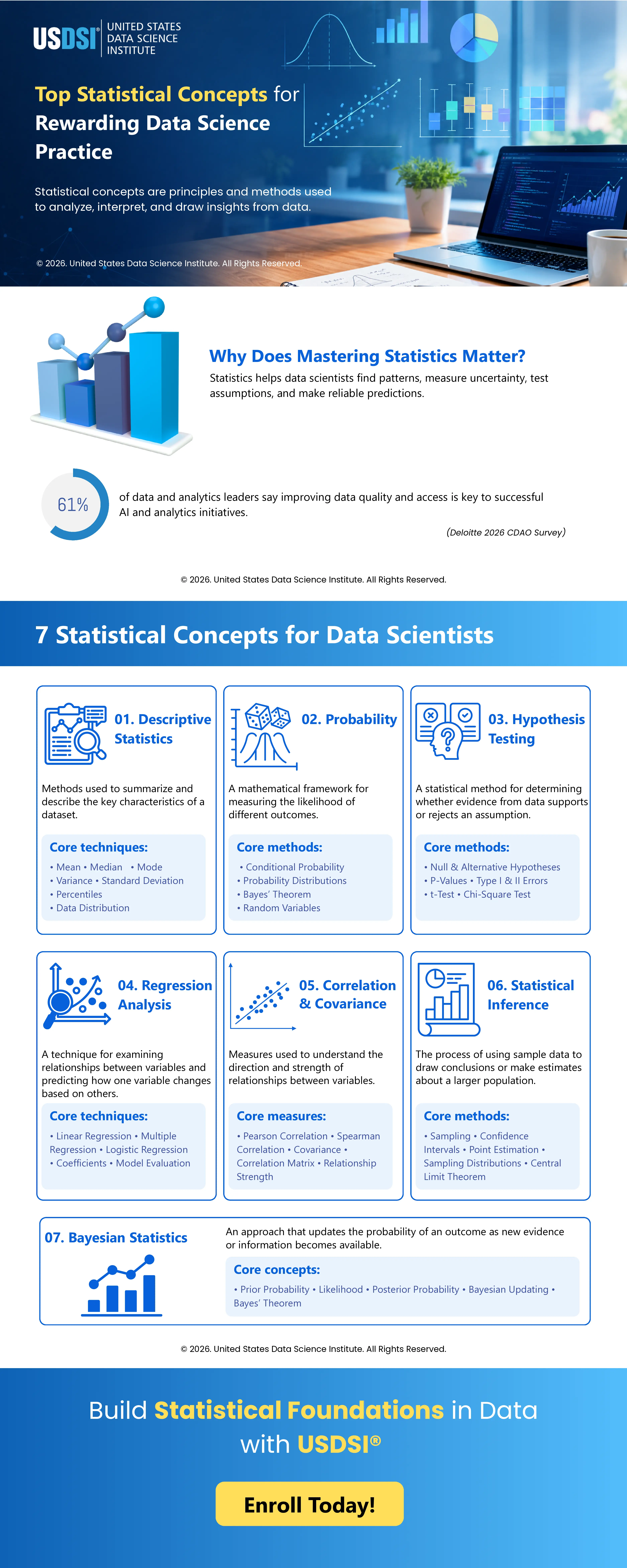
From descriptive statistics and probability to hypothesis testing, regression analysis, correlation, statistical inference, and Bayesian methods, these seven concepts form the backbone of trustworthy data science work. Each one shows up repeatedly in real projects, whether you are testing an assumption, building a predictive model, or explaining results to a non-technical stakeholder.
USDSI® certifications are built around this same theoretical foundation, pairing statistics with practical machine learning so professionals develop both together rather than in isolation.
Explore the full breakdown of these concepts and strengthen your analytical foundation with USDSI™ Data Science Certification.

 English
 Arabic
 French
 Spanish
 Portuguese
 Deutsch
 Turkish
 Italiano
 Russian
 Romaian
 Portuguese (Brazil)
 Greek
Greek