
How Can Women Compare Motorcycle Jackets and Hoodies for Torso Length Without Sacrificing Coverage?
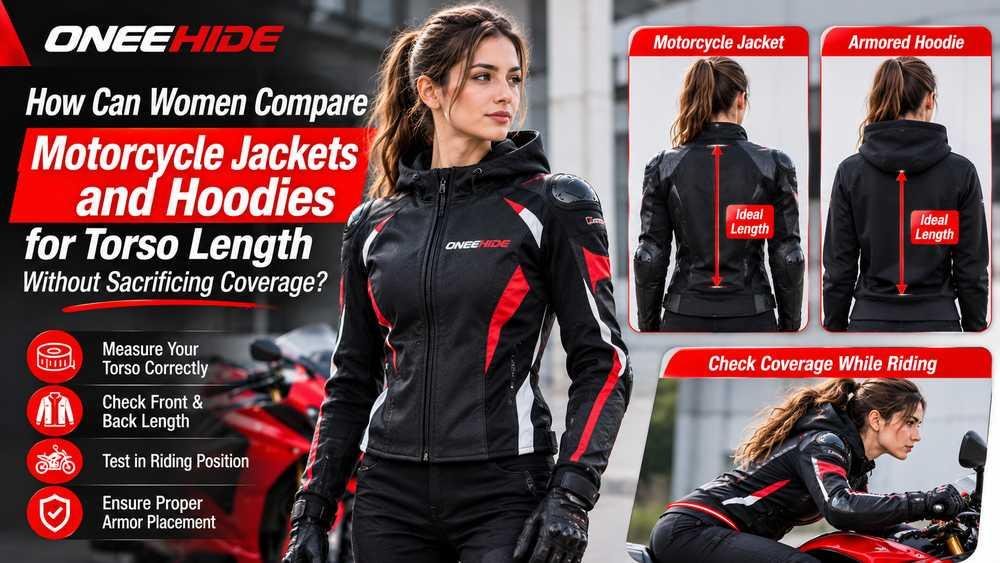
A motorcycle jacket can fit perfectly around the shoulders and bust yet still leave the lower back exposed when a rider leans forward. The opposite problem is equally frustrating: a jacket that provides plenty of rear coverage while standing may bunch around the waist when seated, making it uncomfortable during longer rides.
Women riders often encounter these problems because garment proportions are not determined by overall height alone. Two riders with the same height can have noticeably different torso lengths, waist positions, shoulder widths, and hip proportions. Choosing a jacket or hoodie based only on its labelled size can therefore result in an uncomfortable fit or protective components that do not remain correctly positioned.
The decision becomes more interesting when comparing traditional motorcycle jackets with armored hoodies. Both can provide motorcycle-specific protection, but their construction, length, adjustment options, and intended riding applications can differ considerably. Understanding how to assess torso length in the actual riding position helps women choose clothing that provides adequate coverage without restricting movement.
Why Torso Length Matters More Than Overall Jacket Size
Torso length determines how much of the rider's upper body a motorcycle garment covers, particularly around the waist and lower back.
A jacket can have the correct chest measurement but still be too short in the body. Similarly, increasing the size may provide additional length while creating excessive room around the shoulders, bust, or waist.
For women comparing women's motorcycle gear, the important distinction is between overall garment size and individual body proportions.
A suitable garment should accommodate the rider's torso while keeping its protective material and impact protectors in their intended positions.
What Happens When a Motorcycle Jacket Is Too Short?
A jacket that is too short can move upwards when the rider reaches forward towards the handlebars.
This may expose the lower back or create a gap between the jacket and riding trousers. The problem can become more noticeable on sport motorcycles because the rider adopts a forward-leaning position.
Other potential issues include:
-
The rear hem moving above the trouser waistband.
-
Reduced coverage around the lower back.
-
Difficulty maintaining a secure jacket-to-trouser connection.
-
Excessive tension around the chest and waist.
-
The garment requiring repeated adjustment during a ride.
A short jacket is not automatically unsafe, but its design must provide suitable coverage in the intended riding position. Where the garment is designed to connect to riding trousers, the connection system can help maintain coverage.
Why an Overly Long Jacket Can Also Be Uncomfortable
Additional length is not always the solution.
A jacket that extends too far below the waist may bunch around the hips when the rider sits down. This can create pressure against the fuel tank, interfere with body movement, and make longer journeys uncomfortable.
The front and rear lengths also matter differently. Some motorcycle jackets have a longer back section to maintain rear coverage while allowing the front to sit comfortably when leaning forward.
The objective is to select a garment with appropriate front-to-back proportions rather than simply choosing the longest available design.
Motorcycle Jackets vs. Armored Hoodies: Which Offers Better Torso Coverage?
Motorcycle jackets and armored hoodies can both provide protective coverage, provided they are designed and tested as motorcycle garments.
However, their construction and usual design priorities are different.
Traditional motorcycle jackets often incorporate structured panels, adjustable waist closures, dedicated armour pockets, and jacket-to-trouser connection systems.
Armored hoodies tend to offer a more casual appearance, with textile or sweatshirt-style outer construction and integrated protective components. Their torso length and lower-hem design can vary significantly between models.
|
Feature |
Motorcycle jacket |
Armored motorcycle hoodie |
|
Body construction |
Often more structured |
Generally more casual in appearance |
|
Waist adjustment |
Common on many models |
Depends on the design |
|
Lower-back coverage |
Varies by cut and length |
Varies by cut and length |
|
Protective components |
Depends on certification and model |
Depends on certification and model |
|
Riding applications |
Road, touring, sport, and other uses |
Primarily intended applications specified by manufacturer |
|
Fit considerations |
Bust, waist, hips, and torso proportions |
Torso length, hoodie shape, armour position, and hem stability |
Neither category automatically provides better protection.
A properly certified motorcycle hoodie may provide the protection appropriate to its classification, while an ordinary fashion hoodie with inserted pads may offer no comparable tested abrasion performance.
When a Traditional Motorcycle Jacket Makes More Sense
A dedicated motorcycle jacket may be a better choice for riders who need more structured torso adjustment or additional weather protection.
Many models include waist adjusters, connection zippers, and different back-length patterns.
These features can make it easier to achieve a secure fit across the waist and hips, particularly when the jacket is worn with compatible motorcycle trousers.
Touring-oriented jackets can also provide additional length and coverage, although the exact construction depends on the manufacturer.
When an Armored Hoodie Is Worth Considering
An armored hoodie may appeal to riders who prefer casual styling for everyday commuting and urban riding.
Some models include reinforced outer fabrics, shoulder and elbow protectors, and pockets for compatible back protectors.
However, the lower hem should be examined carefully. A hoodie that fits comfortably while standing may rise when the rider leans forward or stretches towards the handlebars.
Riders exploring different armored motorcycle hoodies should therefore examine the actual back length, waist construction, and armour positioning instead of assuming that a sweatshirt-style garment will fit like a conventional riding jacket.
How Women Should Measure Torso Length for Motorcycle Clothing
A proper torso measurement helps identify whether a jacket or hoodie has enough length to cover the rider in a normal seated position.
Height alone is not sufficient. Measurements around the bust, waist, upper hips, and back length provide a more useful picture of how the garment needs to fit.
1. Measure the Front Torso
Start from the base of the neck and measure down the front towards the desired lower hem position.
The final measurement should reflect the garment length needed to cover the torso comfortably without creating excessive material around the waist.
Motoport's women's jacket sizing guide specifically treats front jacket length as a personal measurement and recommends comparing it against an existing motorcycle jacket where possible.
2. Measure the Back Torso
Measure from the base of the neck down the centre of the back towards the preferred hem position.
This measurement is particularly important because rear coverage can change when the rider leans forward.
Compare the desired length with a jacket that already provides suitable coverage while seated.
3. Measure Bust, Waist, and Hip Circumference
A torso-length measurement should not be considered separately from the rider's body proportions.
Record:
-
Bust circumference at the fullest point.
-
Natural waist circumference.
-
Upper-hip circumference.
-
Full hip circumference where relevant.
These measurements help the manufacturer determine how the jacket should transition from the bust to the waist and lower hem.
A garment that provides adequate length but is excessively tight around the waist or hips may still be unsuitable.
4. Measure in the Intended Riding Configuration
Take measurements with the base layers normally worn underneath the garment.
For a custom order, provide the manufacturer with the motorcycle clothing and protective equipment that will be used together.
Motoport's women's motorcycle jacket sizing guide also asks for individual body measurements, including bust, waist, upper hips, and sleeve length while gripping the handlebars.
This is a useful example of why motorcycle clothing measurements should account for riding posture rather than ordinary clothing proportions.
The Seated Fit Test: Does the Garment Maintain Coverage?
The most reliable way to compare jacket and hoodie torso length is to test both while seated on the motorcycle.
A garment that looks appropriately long in front of a mirror may behave differently when the rider reaches forward or bends at the waist.
RevZilla's guide to finding women's motorcycle gear that fits recommends evaluating gear while seated on the actual motorcycle rather than relying primarily on standing comfort.
Use the following checks.
Forward-Leaning Riding Position
Sit on the motorcycle, place both hands on the handlebars, and adopt your normal riding posture.
Check whether the lower back remains covered and whether the front of the garment creates uncomfortable folds.
A sportbike rider will generally need to assess a more forward-leaning position, while a cruiser rider should evaluate the more upright posture associated with that motorcycle.
The garment should accommodate the intended riding position without pulling excessively across the chest or waist.
Rear Hem and Waistband Coverage
Ask someone to observe the back of the jacket while you remain seated.
Look for gaps between the garment and the waistband of your riding trousers.
If the hem moves significantly above the waistband, consider a longer rear cut, a different size proportion, or a compatible jacket-to-trouser connection.
Motoport's guidance provides a useful manufacturer-specific example: it advises that jackets ending less than 2.5 inches below the waist beltline should always be zipped to the trousers. Its recommendation is specific to its sizing guidance, not a universal requirement for all motorcycle jackets.
Hip and Waist Movement
Move naturally from side to side while remaining seated.
An excessively long jacket may bunch against the hips, while a short or tightly fitted garment can pull upward.
Check whether the jacket permits normal movement without exposing the lower back or creating uncomfortable pressure.
Does the Jacket or Hoodie Keep Its Armour in the Correct Position?
Torso coverage is only one part of protective fit.
Shoulder, elbow, and back protectors must remain correctly positioned when the rider moves.
A jacket that covers the lower back but allows its elbow armour to move excessively is not providing an ideal fit.
Pay particular attention to these areas:
Shoulder protection: The protector should remain aligned with the shoulder rather than shifting towards the upper arm.
Elbow protection: The elbow insert should continue covering the elbow when the arm bends and reaches towards the handlebars.
Back protection: A compatible back protector should remain in its intended pocket and cover the appropriate area.
Waist and hem: The garment should remain stable without excessive movement during riding.
The SATRA explanation of EN 17092:2020 describes the requirements for motorcycle protective garments, including the positioning of impact protectors and fit-related ergonomic assessments.
The standard identifies five garment performance classes: AAA, AA, A, B, and C.
Class AAA and AA garments have mandatory shoulder, elbow, knee, and hip impact-protector requirements according to the applicable design, while hip protectors are optional for Class A garments. Class B garments provide abrasion protection without included impact protectors, while Class C garments provide impact protection in their covered areas but no minimum abrasion protection.
This distinction is important when comparing jackets and hoodies. Protective pads alone do not establish that the complete garment offers certified motorcycle protection.
Which Torso Fit Should You Prioritise for Different Riding Styles?
The ideal torso length depends partly on riding posture and the type of motorcycle.
|
Riding style |
Important fit priority |
|
Sportbike |
Rear coverage while leaning forward |
|
Naked motorcycle |
Balanced front and rear torso length |
|
Cruiser |
Comfortable waist and hip coverage in an upright position |
|
Touring |
Stable lower-back coverage during extended seated riding |
|
Urban commuting |
Comfortable coverage during frequent mounting and movement |
A sportbike rider may prefer a jacket with an extended rear section and a shorter front to accommodate the forward riding position.
A cruiser rider may benefit from a straighter torso cut that does not bunch around the waist while sitting upright.
For mixed riding, a balanced design with adjustable waist features and suitable rear length may be more practical.
These are fitting priorities rather than strict rules. Individual body proportions and garment construction can change the recommendation.
How to Choose Between Standard and Custom-Fit Motorcycle Clothing
Standard sizing is usually sufficient when a jacket or hoodie provides appropriate coverage, comfortable movement, and correct armour positioning.
However, custom sizing becomes worth investigating when standard options repeatedly create the same fit problem.
For example, a woman may find that jackets fitting her bust are consistently too short in the torso, while longer sizes become excessively loose around the shoulders and waist.
In that situation, increasing the overall size may not solve the underlying proportion problem.
A custom-fit garment can potentially accommodate individual torso length, bust measurements, waist shape, shoulder width, and sleeve proportions more precisely.
Before ordering, provide the manufacturer with:
-
Front and back torso measurements.
-
Bust and waist measurements.
-
Upper and full hip measurements.
-
Height and shoulder width.
-
Preferred riding posture.
-
Intended base layers.
-
Photographs of the garment while seated on the motorcycle.
Ask for front, back, and side views of the proposed fit before approving production.
A Practical Coverage Checklist Before Buying
Before choosing between a motorcycle jacket and an armored hoodie, evaluate the complete garment rather than relying on its appearance or size label.
-
The torso length suits your body proportions.
-
The lower back remains covered while seated.
-
The front hem does not bunch uncomfortably.
-
The garment fits comfortably around the bust and waist.
-
The shoulder and elbow armour remain correctly positioned.
-
The back protector fits its intended pocket.
-
The garment works with your riding trousers.
-
The sleeves and cuffs maintain suitable wrist coverage.
-
The protective clothing classification has been verified.
-
All important movements remain comfortable.
A useful final step is comparing two or more garments while wearing the same trousers and base layers. This helps reveal differences in torso length without introducing other fitting variables.
The better motorcycle jacket or hoodie is not necessarily the one with the longest body or the smallest size label. It is the garment that follows the rider's actual proportions, maintains coverage in the intended riding position, and keeps its protective components where they belong.
Add a direct OneeHide fit-focused call to action

 English
 Arabic
 French
 Spanish
 Portuguese
 Deutsch
 Dutch
 Italiano
 Russian
 Romaian
 Portuguese (Brazil)
 Greek