
Lean Six Sigma Training Australia: Build Practical Skills
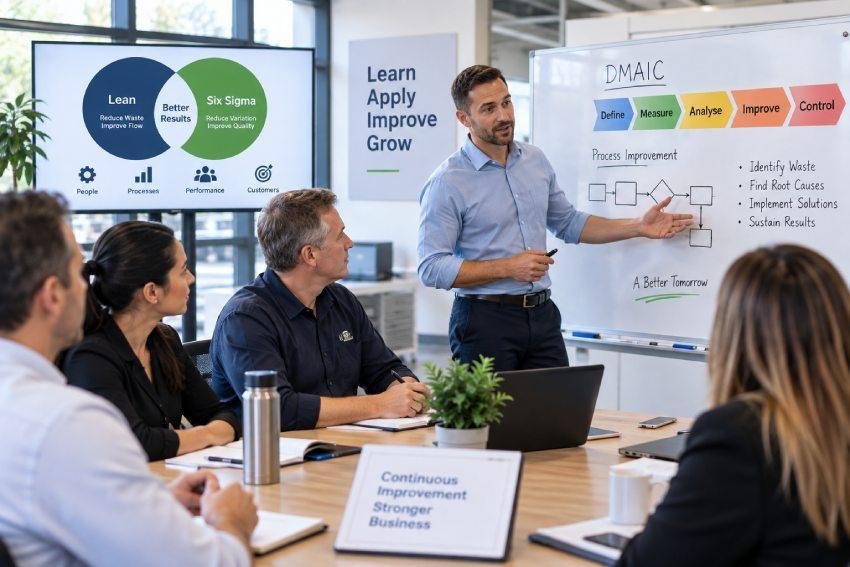
Australian businesses are under constant pressure to improve productivity, reduce operating costs, maintain quality and deliver better customer outcomes. Whether an organisation operates in manufacturing, healthcare, logistics, construction, government or professional services, inefficient processes can affect performance and profitability.
This is where Lean Six Sigma training Australia can provide practical value. Lean Six Sigma combines Lean principles, which focus on reducing waste, with Six Sigma methods, which focus on reducing process variation and improving quality.
The aim is to help organisations understand how work is performed, identify the causes of problems and make improvements based on evidence. With the right training, employees and managers can develop the skills needed to support continuous improvement and long-term business performance.
What Is Lean Six Sigma Training?
Lean Six Sigma training teaches participants how to identify process problems, analyse performance and develop structured improvement solutions. The training combines practical Lean tools with data-based Six Sigma methods.
Lean focuses on improving flow and removing activities that do not create value for the customer. Six Sigma focuses on reducing errors, variation and defects by using data and structured problem-solving techniques.
Together, these methods help organisations improve processes rather than simply asking employees to work faster.
Depending on the course level, Lean Six Sigma training may cover process mapping, waste identification, root cause analysis, process measurement, improvement planning, standardisation and performance monitoring.
Why Lean Six Sigma Training Australia Is Important
Australian organisations operate in competitive markets where customers expect reliable service, consistent quality and fast responses. Small process problems can become expensive when they happen repeatedly across a team or department.
Employees may spend time waiting for approvals, correcting errors, searching for information, moving materials or repeating administrative tasks. These activities can reduce productivity without adding value to the customer.
Lean Six Sigma training helps employees recognise these problems and understand how they affect the wider business process.
The training can also create a common improvement language across departments. When employees understand concepts such as waste, variation, root causes and process flow, they can work together more effectively to solve problems.
Key Topics Covered in Lean Six Sigma Training
A well-designed Lean Six Sigma course usually begins with an understanding of Lean thinking and customer value. Participants learn how to identify what customers need and how business processes contribute to that outcome.
Waste reduction is another important topic. Lean identifies different forms of waste, including waiting, defects, rework, over-processing, excess inventory, unnecessary movement and underused employee skills.
Participants may also learn process mapping and value stream mapping. These tools help teams visualise how work, materials and information move through a process. Mapping can reveal delays, duplication, unnecessary handovers and bottlenecks.
Root cause analysis is used to understand why a problem occurs. Instead of treating only the visible symptom, employees learn how to investigate the underlying causes.
Six Sigma training may also introduce data collection, process measurement, variation analysis and the DMAIC improvement method. DMAIC stands for Define, Measure, Analyse, Improve and Control.
Understanding the DMAIC Method
The DMAIC method provides a structured approach for improving an existing process.
During the Define stage, the team identifies the problem, customer requirement, project objective and expected business outcome.
The Measure stage focuses on collecting information about current process performance. This may include processing time, defect levels, waiting time, customer complaints or delivery performance.
During Analyse, the team investigates the reasons behind the problem. Data, process observations and root cause analysis can help identify where performance is being affected.
The Improve stage involves developing and testing practical solutions. These may include changing workflows, removing unnecessary steps, improving communication or standardising activities.
The Control stage focuses on maintaining the improvement. Teams may use updated procedures, performance measures, regular reviews and clear process ownership to ensure the gains continue.
Who Can Benefit From Lean Six Sigma Training?
Lean Six Sigma training Australia can benefit professionals working in many different roles and industries.
Operations managers can use the methods to improve workflow and resource utilisation. Quality professionals can apply the tools to reduce defects and improve consistency. Project managers can use structured problem-solving to manage risks and improve project delivery.
Manufacturing employees may use Lean Six Sigma to improve production flow, reduce downtime and minimise rework. Healthcare teams can apply the methods to patient administration, scheduling and service delivery. Logistics businesses can use process improvement to reduce delays in picking, packing and delivery.
The training can also support employees in government, education, finance, construction, administration and professional services.
Benefits of Lean Six Sigma Training Australia
One of the main benefits of Lean Six Sigma training is improved problem-solving capability. Employees learn how to understand a problem before selecting a solution.
The training can also support better productivity by helping teams reduce unnecessary activities and improve process flow. When employees spend less time waiting, searching, correcting errors or repeating work, more time can be directed towards value-adding activities.
Quality improvement is another important benefit. By identifying the causes of defects and variation, organisations can develop more consistent processes and reduce rework.
Lean Six Sigma training can also improve employee involvement. Employees who understand improvement methods may feel more confident sharing ideas, identifying waste and participating in workplace improvement projects.
Over time, these skills can help create a culture where continuous improvement becomes part of everyday business operations.
Lean Six Sigma Certification and Career Development
Lean Six Sigma certification can support professionals who want to develop their knowledge of process improvement and operational performance.
Different training levels may be available depending on the participant’s experience and responsibilities. Introductory courses can help employees understand basic Lean principles and improvement tools. More advanced training may focus on data analysis, project leadership and complex process improvement.
Certification can be useful for professionals working in operations, quality, supply chain, project management, manufacturing and business improvement.
However, completing a certificate is only one part of professional development. The greatest value comes from applying the skills to real workplace challenges and achieving measurable improvements.
How to Choose Lean Six Sigma Training in Australia
When selecting Lean Six Sigma training, businesses should consider whether the course is practical, relevant and suitable for their team.
The course should explain how Lean Six Sigma tools can be applied to real business situations. It should also provide opportunities for participants to work through examples, analyse processes and develop improvement ideas.
Organisations should consider the trainer’s experience, course structure, delivery format and level of support provided after training.
It is also useful to choose training that matches the organisation’s goals. A business focused on workplace organisation may benefit from 5S training, while a business dealing with process delays may require value stream mapping or broader Lean improvement training.
The Role of a Business Improvement Consultant
A business improvement consultant can help organisations connect Lean Six Sigma training with practical improvement projects.
The consultant may support process reviews, workshop facilitation, waste identification, performance measurement and improvement planning. They can also help managers select suitable projects and track results after training.
This approach helps ensure that Lean Six Sigma knowledge is not limited to classroom learning. Instead, employees can apply the methods to real processes and contribute to measurable business improvements.
Why Choose Efficiency Works?
Efficiency Works supports Australian organisations with Lean Six Sigma training, continuous improvement and business efficiency consulting.
Its approach focuses on practical methods that help employees and managers understand process problems, reduce waste and improve business performance.
Training and consulting support may include Lean continuous improvement, process improvement, value stream mapping, 5S training, strategic planning, leadership development and change management.
The objective is to help organisations build internal capability while developing improvements that can be maintained over time.
Conclusion
Lean Six Sigma training Australia can help businesses improve productivity, reduce waste, strengthen quality and develop practical problem-solving skills.
By combining Lean principles with Six Sigma methods, organisations can better understand their processes and make improvements based on evidence rather than assumptions.
The training is relevant across manufacturing, healthcare, logistics, construction, government, professional services and many other industries.
When supported by leadership involvement, employee participation and measurable improvement projects, Lean Six Sigma training can become an important foundation for continuous improvement and long-term business success.

 Arabic
 French
 Spanish
 Portuguese
 Deutsch
 Turkish
 Dutch
Dutch
 Italiano
 Russian
 Romaian
 Portuguese (Brazil)
 Greek
Greek